
How Import-Export SMEs Apply AI Successfully?
When SMEs struggle to adopt AI, it’s almost never because the technology itself didn't work. It usually comes down to three things: internal data is a complete mess, daily workflows are scattered all over the place, and leadership is rightfully terrified of leaking trade secrets or falling out of compliance.
Sit down with the team, watch where they get stuck, where the struggles are, and what they want to fix. Keep the whole thing dead simple and focused on actual ROI.
Start with the highest-cost, highest-risk bottlenecks in your everyday import-export operations. Tackle those first. Clear up your data security boundaries early on so everyone knows where the guardrails are. Feed your AI actual, real-world business context—not generic prompts—and always, always keep a human expert in the loop to audit every single output before it goes out the door.
At the end of the day, as business leaders, what we actually want isn't complicated:
- Less time buried under endless piles of shipping paperwork.
- Real peace of mind around legal safety and compliance.
- The quiet confidence to sign off on international deals without constantly second-guessing every detail.
Fix the foundation, protect your data, and the tech will follow.
Why Import-Export SMEs Fail at AI Implementation?
I have seen far too many Import-Export teams rushing try out public AI tools for heavy tasks—auditing Letters of Credit, sorting out HS Codes, or running compliance checks—only to give up shortly after.
They panic and halt everything. Honestly? I believe they are completely right to be scared.
What takes place behind the scenes is classic "Shadow AI" — a staff quietly copying and pasting raw data into public AI tools simply to finish their work faster.
Doing so, they are leaking the core pricing logic, farm-gate purchasing costs, and confidential sourcing directories to public servers. Our precious trade secrets, lost in a single click.
Then comes the legal nightmare.
Uploading draft contracts or detail into of your B2B contact info public AI actually counts as a cross-border data transfer under Decree 13/2023/NĐ-CP. That immediately triggers mandatory Data Protection Impact Assessments and exposes your business to fines up to 1 billion VND—or 5% of your annual revenue.
If you deal with EU buyers, you are also walking directly into severe compliance traps under GDPR and Article 50 of the EU AI Act.
The 3-Step Practical Framework for AI Implementation in Import-Export SMEs
When bring AI into your import-export operations without risking your company, it comes down to three practical steps.
- Clean up your data and draw a line. Before anyone on your team types a single prompt, establish clear boundaries around your company data:
- Level 1 (Off-limits): Your real profit margins, COGS, product technical specs, raw supplier lists, loan records, and buyer pricing histories. In my view, these must stay far away from public AI tools. Period.
- Level 2 (Proceed with caution): Draft contracts, negotiation threads, B/L terms, and internal reports. You can leverage AI here, but only after carefully scrubbing sensitive details first—masking names, prices, and proprietary facts.
- Level 3 (Safe to use): Public spec sheets, promotional copy, and general import rules. Feel completely free to explore.
- Give the AI real grounding. Ever heard of AI hallucination? Yes, AI can makes stuff up whenever it works in a vacuum. If you want reliable, high-quality results, you must feed it verified reference materials. Drop in official up-to-date HS Code database, target market regulations, Phytosanitary requirements, EUR.1 rules…. to anchor its reasoning. Make it work directly off your authentic trade context.
- Keep a human in the loop. Let the AI assist with the rough draft, but never let itself approved without a human staff to check. Before any quote, B/L, or contract goes out the door, your process expert needs to look it over. At the end of the day, legal accuracy and accountability still remain in our hands.
The 3 Core Operational Principles Before AI Implementation
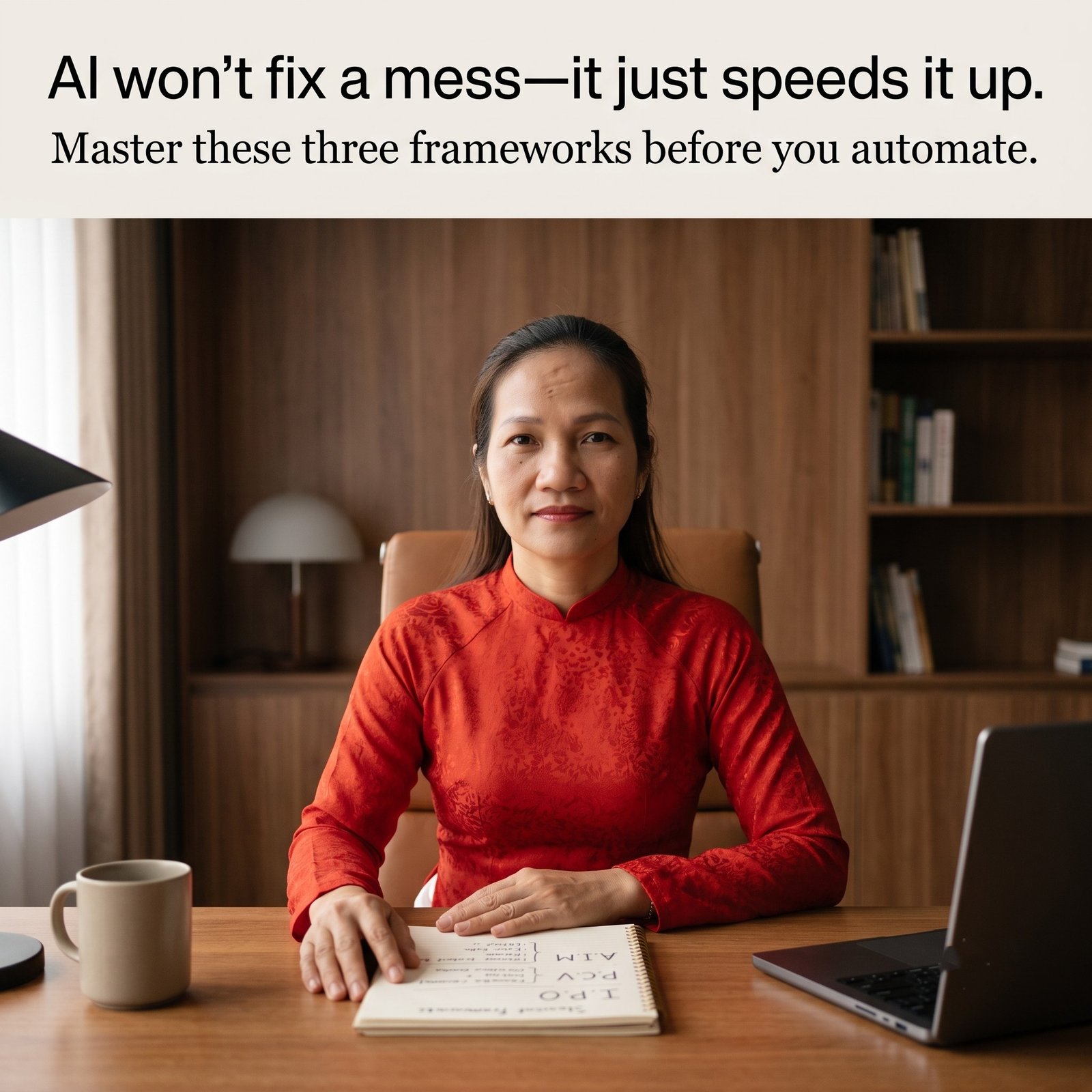
Before you throw any AI tools into your daily workflow, sit down and do these three frameworks (I.P.O – P.C.V – A.I.M – I know, you won’t remember these fancy acronyms, I want what actual work as well). Honestly, AI won't fix a mess. It just speeds it up.
1. Map your inputs, processes, and outputs (I.P.O) Look at every workflow and break it down simply: What goes in? What gets done? What comes out? If you haven't standardized a process yourself, an algorithm isn't going to magically organize it for you.
2. Spot the real bottlenecks and measure the value (P.C.V) Find the exact pain point (Problem). Figure out what actually needs to improve (Change). Then ask the hard question: Is the ROI (Value) worth the tech, or are you just complicating something simple? Don't overhaul how you operate if a quick tweak does the job.
3. Constructing your prompt (A.I.M Actor - Intention - Mission): a solid framework for how you prompt it—and how you cover your legal back. Tell it what authoritative references to use (Actor). Lay out the exact steps it needs to follow (Intention). Then define the exact deliverable format you expect (Mission). Simple, grounded, and leaves very little room for hallucinations.
When it comes to using AI in daily ops, covering your legal back is down to three basic habits.
- Draw clear lines around what can upload into public AI and what stays locked down. If your team doesn't know where the guidelines are, mistakes will happen.
- Don't let AI work in a uncleared source of data or it will just make things up. Feed it your actual reference documents, trade data, and regulations.
- Never let an AI-generated document leave your office without a real expert reviewing it first. It’s your last line of defense for domestic compliance and international buyer expectations.

18-year experience in Import & Export - with a strong background in international commerce, I am confident in bringing my agro-export knowledge to friends and partners around the world - contributing in elevating the value of Vietnamese agriculture on the international stage.
Join Our Group to Learn & Share Toghether

Join our Comunity - Lifestyle IdeaSpace - Collaborative Space for Learning & Sharing – a space we’ve created for everyone to share, connect, and learn together.