
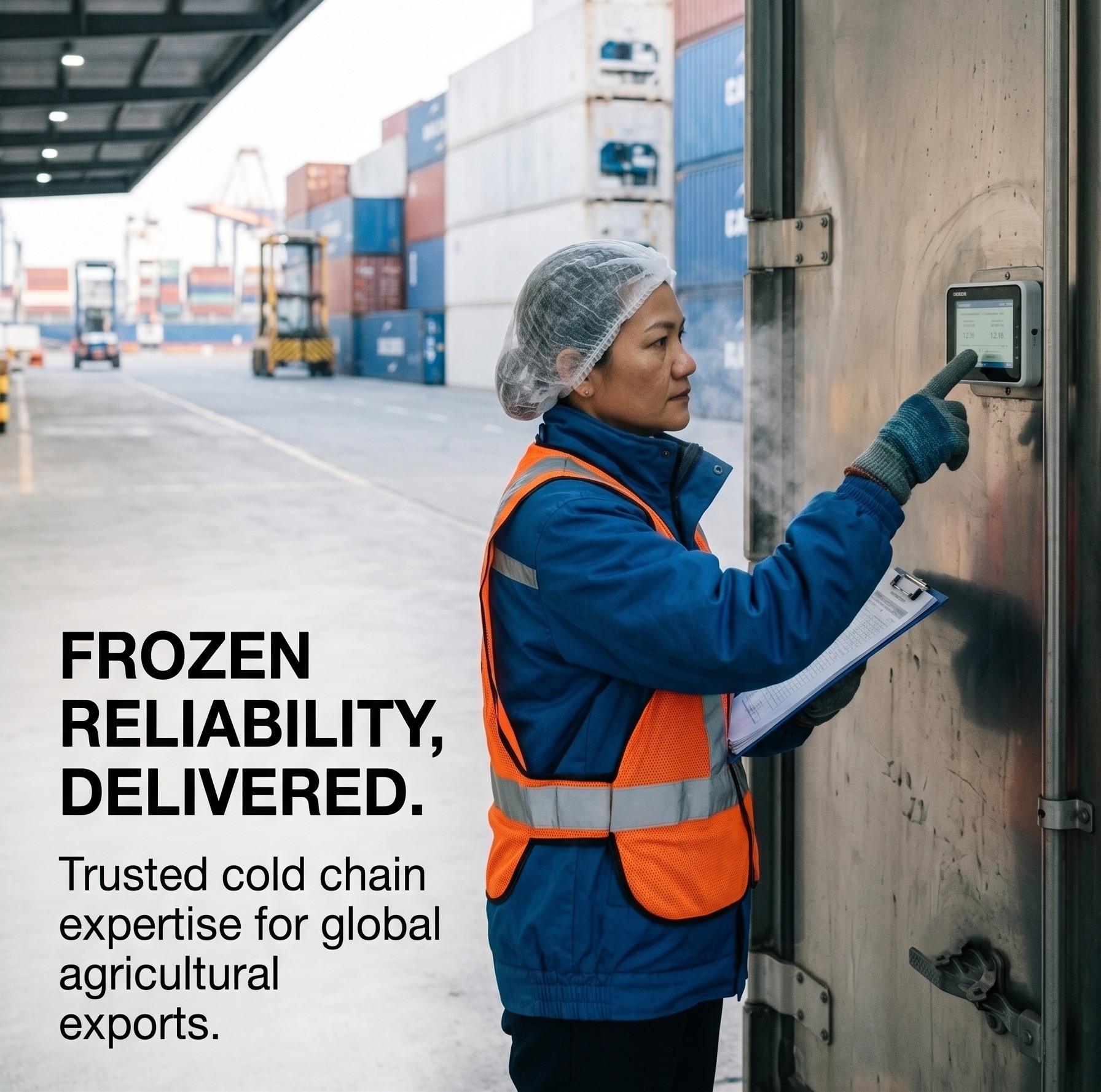
How do vietnamese suppliers handle cold chain logistics and mitigate risk during sea freight delays?
Vietnamese frozen and processed fruit exporters handle sea freight delays through a rigorous 3-Tier Cold Chain Risk Management SOP—combining precise pre-cooling and Pre-Trip Inspections (PTI) at the ground level, proactive rerouting and continuous power monitoring at transshipment hubs, and strategic contract negotiations securing 14–21 days of Combined Free Time (DEM/DET) alongside comprehensive Cold Chain Interruption insurance.
What do our Vietnamese Factories need to do:
- Operational Agility (Tier 1): Execute mandatory Pre-Trip Inspections (PTI) on reefer containers before loading. Enforce strict pre-cooling at processing facilities to bring core product temperatures down to required setpoints—Deep Frozen IQF fruit (mango, durian, dragon fruit) at -18°C to -20°C with air vents fully closed, and Chilled/Puree products at 0°C to 4°C with proper airflow. Never load cargo above target core temperature to avoid overworking container cooling units.
- Management Intervention (Tier 2): Actively monitor vessel schedules and carrier notifications. Upon blank sailings or port congestion warnings at major local gateways (Cát Lái, Cái Mép, Hải Phòng), execute rerouting scenarios immediately. Ensure continuous plug-in power and log temperature continuous tracking during yard dwell times. Maintain zero-error documentation across Bills of Lading, Phytosanitary Certificates, and Certificates of Origin to eliminate customs clearance holds.
- Executive Leadership (Tier 3): Negotiate extended Combined Demurrage & Detention (DEM/DET) terms (14–21 days) in master agreements with shipping lines to establish a financial buffer against destination port delays. Secure comprehensive marine cargo insurance policy clauses covering Cold Chain Interruption and delay-induced spoilage.
What do our Sourcing Managers need to do:
- Partner with processors controlling the value chain from standardized orchards to advanced IQF freezing facilities, ensuring uncompromised core temperature control before loading.
- Mandate the placement of cellular/satellite IoT data loggers inside containers to track return air, supply air, relative humidity, GPS location, and door-open events in real time.
- Agree on Combined Free Time structures (14–21 days) in commercial contracts rather than split DEM/DET to allow flexible allocation between port yards and private cold storage facilities during transit delays.
Export Cold Chain Logistics
The export landscape for Vietnamese processed fruits—such as IQF mango, durian, dragon fruit, and chilled purees—is rapidly shifting toward high-value, deep-processed products. However, with shipments valued at hundreds of thousands of dollars, sea freight delays and port congestion present severe financial risks.
At major Vietnamese gateways like Cát Lái and Cái Mép, yard utilization frequently runs at 80% to 90%, amplifying the impact of blank sailings and transshipment delays in hubs like Singapore or Port Klang Explorate Market Update. When reefer containers face unexpected 1-to-2-week transshipment dwell times, operational discipline becomes the ultimate line of defense.
To mitigate temperature fluctuations and financial losses, leading Vietnamese suppliers deploy a structured 3-Tier Cold Chain Risk Management SOP as described above.
Furthermore, integrating real-time IoT data loggers inside reefer containers provides transparent cloud-based tracking of supply/return air temperatures and GPS locations. This data-driven, vertically integrated approach transforms passive risk mitigation into an active competitive advantage for international buyers.
Industry References & Regulatory Context:
- Shipping line local demurrage/detention tariffs in Vietnam: Evergreen Local Charges, Le Anh Import-Export DEM/DET Guide
- Vietnam Frozen Fruit Market Insights: HFoods Vietnam Frozen Mango Market
- Global Freight Market Updates & Congestion: Explorate Market Update

18-year experience in Import & Export - with a strong background in international commerce, I am confident in bringing my agro-export knowledge to friends and partners around the world - contributing in elevating the value of Vietnamese agriculture on the international stage.
Join Our Group to Learn & Share Toghether

Join our Comunity - Lifestyle IdeaSpace - Collaborative Space for Learning & Sharing – a space we’ve created for everyone to share, connect, and learn together.